How should global EPC procurement teams, switchboard panel builders, and electrical asset managers evaluate, size, and source modern Intelligent Universal Circuit Breakers (Air Circuit Breakers / ACB) under IEC 60947-2? Zhejiang Graybar Electric Co., Ltd. delivers direct-from-factory intelligent switchgear incomer solutions from 630A to 6300A, bridging high breaking capacity (up to 120kA), True RMS digital intelligence, and comprehensive SCADA communication protocols.
The intelligent universal circuit breaker serves as the core incomer and selective protection guardian in modern low-voltage distribution networks. Unlike traditional thermal-magnetic circuit breakers, Graybar intelligent ACBs house an integrated microprocessor controller calculating true RMS currents, phase angles, neutral imbalance, and harmonic pollution up to the 31st harmonic. Designed to provide selective coordination with downstream MCCBs and upstream medium-voltage substations, our ACB portfolio guarantees uninterrupted uptime across industrial plants, commercial campuses, infrastructure hubs, and renewables.
Rated Current: 630A–6300APoles: 3P / 4P Full NeutralTrip Unit: LSI / LSIG MicroprocessorOperation: Manual / MotorizedMOQ: 1 Unit
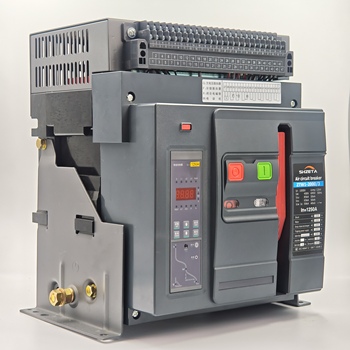
Draw-Out Type Intelligent Universal Circuit Breaker
Engineered for mission-critical switchgear architectures where zero downtime is paramount. Equipped with an ergonomic racking mechanism featuring Disconnected, Test, and Connected positions with mechanical safety interlocks and primary contact shutter covers.
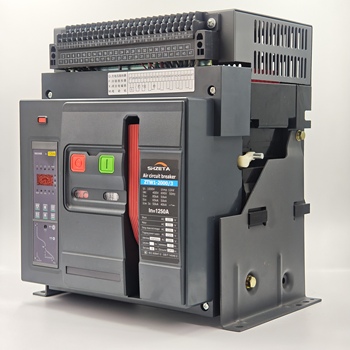
Engineered for cost-sensitive, high-density low-voltage distribution boards, compact transformer direct-mount substations, and generator sets. Eliminates cradle depth, providing full microprocessor protection in space-constrained enclosures.
Mounting FrameFixed bolted direct to copper busbars
Next-Generation Procurement & Technology Trends in Intelligent ACBs
The transition toward decarbonized grids, hyperscale edge computing, and distributed energy resources (DER) is permanently redefining the operating environment for incoming air circuit breakers.
Core Dimension
Traditional ACB Sourcing (Legacy Systems)
Future-Proof Intelligent ACB Trend (2025–2030)
Procurement Impact & Engineering Gain
Trip Unit Architecture
Thermal-magnetic strips or basic analogue electronic relays
DSP-driven Microprocessor Trip Units with True RMS & 31st Harmonic Filtering
Eliminates nuisance tripping caused by high non-linear VFD and solar inverter harmonic loads.
System Telemetry & IoT
Isolated auxiliary contacts (dry contacts for trip status only)
Direct Modbus-RTU, Profibus-DP, Ethernet IP, and IEC 61850 protocol integration
Enables remote sub-millisecond trip waveform capture, current logging, and automated demand response.
Predictive Maintenance
Calendar-based manual overhauls and contact inspection
Algorithmic Contact Wear Accumulation (% wear based on I²t fault energy)
Prevents premature breaker strip-downs; switchboards operate on real condition-based maintenance.
Renewable & BESS Duty
50Hz/60Hz standard sinusoidal AC distribution
High-voltage AC (up to 1140V AC) and bidirectional power-flow endurance
Safeguards centralized solar inverters and battery storage facilities against severe regenerative fault spikes.
Environmental Standards
Basic phenolic mouldings and hazardous plating chemicals
RoHS-compliant, halogen-free thermoplastics with low cradle-to-gate carbon footprints
Satisfies ESG procurement standards enforced by multinational European and American EPC contractors.
AI-Optimized Power Systems Demand Digitally Agnostic ACBs
Artificial intelligence and automated energy management platforms (BEMS) require granular power quality telemetry at the incoming transformer junction. An Intelligent Universal Circuit Breaker is no longer just a passive isolation device; it functions as a primary smart meter and diagnostic transducer. At Zhejiang Graybar Electric Co., Ltd., our engineering R&D incorporates solid-state current transformers (Rogowski coils) and ultra-fast analog-to-digital converters, ensuring voltage, current, active power, reactive power, power factor, and harmonic distortion data are fed directly into building automation systems without costly external metering transformers.
Furthermore, bidirectional power flow in microgrids—where solar arrays and battery banks alternate between drawing and feeding current—requires programmable dual-setting protection groups. Our intelligent trip units allow instantaneous parameter switching via Modbus or digital input when switching between utility-grid mode and isolated islanded generator mode.
Cascading & Discrimination Integration
Complete Coordinated Protection: From Main ACB to Final MCB
Eliminate system nuisance trips. Sourcing your complete low-voltage protection chain from Zhejiang Graybar Electric ensures tested cascading tables, selective discrimination, and uniform component build quality.
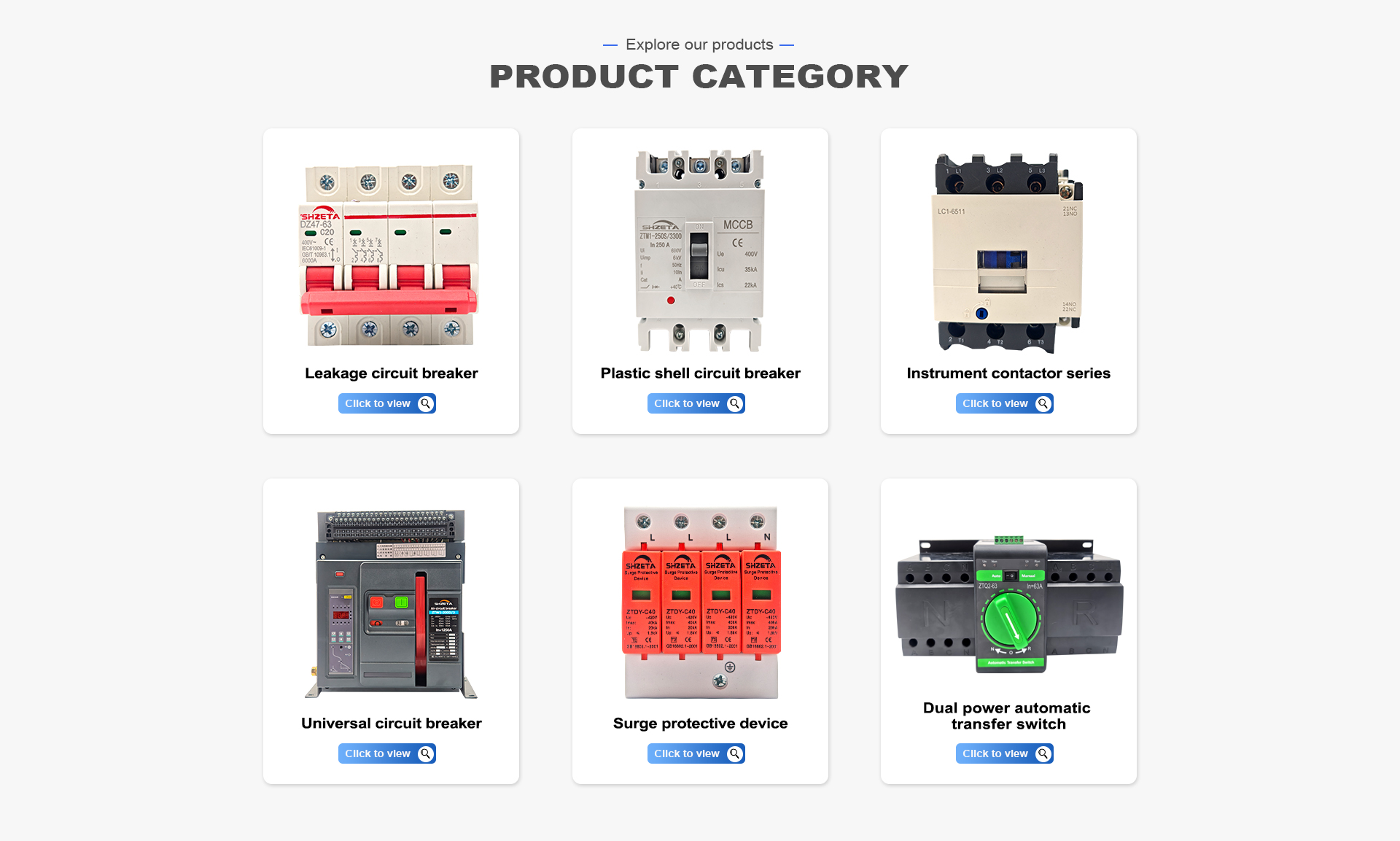
Zhejiang Graybar Electric Co., Ltd. is an authentic manufacturer and exporter specialized in industrial low-voltage circuit protection, power switching, and distribution automation devices. Operating from Huangyu Village, Liushi Town, Wenzhou—the world's most concentrated manufacturing cluster for switchgear apparatus—we provide high-performance Intelligent Universal Circuit Breakers (ACB), Moulded Case Circuit Breakers (MCCB), Miniature Circuit Breakers (MCB), Surge Protective Devices (SPD), Dual Power Automatic Transfer Switches (ATS), and AC Contactors.
Our engineering philosophy centers on structural longevity and trip reliability. By maintaining comprehensive in-house control over core contact riveting, magnetic release calibration, arc-extinguishing splitter grid assembly, and microprocessor controller programming, we ensure our global partners receive devices that consistently surpass baseline IEC/EN standards without inflated pricing.
Registered Address: Huangyu Village, Liushi Town, Wenzhou, Zhejiang, China
Factory Classification: Authenticated Manufacturer & International Exporter
Engineering Credential: Design compliant with IEC 60947-2, IEC 60898-1, IEC 61643-11, and IEC 60947-6-1
ACB, MCCB, and switchgear automated calibration and test facilityLow-voltage power distribution and switching component range
Standard Compliance & Verification
International Compliance Framework
Ensuring compliance risk is totally eradicated prior to customs clearance and site commissioning.
IEC 60947-2
Air & moulded case circuit breakers: breaking capacity, dielectric test & selective withstand (Icw)
IEC 60898-1
Miniature circuit breakers for commercial and residential branch distribution
IEC 61643-11
Low-voltage surge protective devices tested for 8/20μs and 10/350μs transient wave shapes
IEC 60947-6-1
Multiple-operation automatic transfer switching equipment for emergency and critical power
IEC 60947-4-1
Electromechanical contactors and motor starters rated for AC-1, AC-3, and AC-4 switching duty
Official factory type-test reports, third-party laboratory verification, and declaration of conformity files available on request. Forward your tender specifications to [email protected].
Enterprise Transparency
Independently Audit Our Manufacturing Credibility
Review authenticated financial standing, buyer reviews, workshop audits, and past export documentation.
In-depth technical answers addressing the critical parameters queried by electrical contractors, panel builders, and project engineers.
What constitutes an "Intelligent" Universal Circuit Breaker compared to conventional standard ACBs?
An Intelligent Universal Circuit Breaker replaces legacy analog thermal-magnetic and electromechanical tripping assemblies with a dedicated, solid-state microprocessor trip unit (often called an Intelligent Controller). This microprocessor samples instantaneous current and voltage waveforms using high-precision onboard Rogowski coils and iron-core current transformers, executing True RMS mathematical calculations up to the 31st harmonic.
Beyond standard Long-time overload (L), Short-time short-circuit (S), and Instantaneous short-circuit (I) protection, an intelligent ACB integrates Ground-fault protection (G), phase unbalance detection, thermal memory, undervoltage/overvoltage tripping, reverse power protection, and frequency deviation monitoring. Crucially, it houses digital memory logging fault types, fault magnitude, and millisecond timestamps, while broadcasting telemetry across RS485 (Modbus-RTU) or Ethernet networks directly to SCADA systems without requiring outboard transducers.
When should an engineering specification demand a Draw-Out ACB instead of a Fixed Type ACB?
The decision between Draw-Out (withdrawable) and Fixed configurations hinges on service continuity, downtime tolerance, and enclosure physical dimensions:
Draw-Out ACB: Indispensable for hospitals, data centers, continuous chemical processes, marine vessels, and primary utility substations. The breaker body is mounted inside a specialized draw-out cradle. Using an external racking handle, maintenance engineers can rack the breaker through three mechanical positions: Connected, Test (auxiliary control circuits live, main power stabs isolated), and Disconnected. If internal overhaul or contact replacement is required, the chassis can be fully withdrawn in under 15 minutes without de-energizing the main vertical switchboard busbars, ensuring maximum personnel safety via automatic insulating shutters.
Fixed Type ACB: Ideal for budget-conscious installations, standalone OEM machinery panels, and compact package substations where physical enclosure depth is restricted. Because the breaker is bolted directly to the incoming copper busbars, any major inspection or replacement requires a complete shutdown of upstream power.
What breaking capacity parameter (Icu vs Ics) should global EPC procurement teams prioritize?
Procurement teams and panel builders must scrutinize the ratio of Rated Service Short-Circuit Breaking Capacity (Ics) to Rated Ultimate Short-Circuit Breaking Capacity (Icu) under IEC 60947-2 sequence tests.
Icu represents the absolute maximum fault current the circuit breaker can interrupt under test sequence [O – t – CO] (Open, followed by timed delay, followed by Close-Open). Following this severe test, the breaker is permitted to be electrically inoperable. In contrast, Ics verifies that after clearing a fault of that stated magnitude, the breaker remains fully capable of carrying continuous rated operational current and tripping safely during subsequent standard overloads.
Zhejiang Graybar Electric Co., Ltd. manufactures Intelligent ACBs engineered to achieve Ics = 100% Icu across virtually all frame sizes up to 100kA/120kA at 400V AC. Sourcing an ACB with Ics = 100% Icu ensures maximum asset longevity and prevents costly main-incomer switchboard replacements following a high-energy short-circuit fault.
How does harmonic distortion in modern inverter-fed grids affect ACB selection?
The massive proliferation of variable frequency drives (VFDs), server switching power supplies, electric vehicle chargers (EVSE), and solar PV central inverters introduces severe non-linear currents into distribution systems. These loads generate prominent 3rd, 5th, 7th, 11th, and higher odd harmonics.
Conventional analog breakers measuring simple peak currents will experience erratic false tripping (nuisance trips) or dangerous under-tripping because the peak-to-RMS crest factor shifts drastically from a standard 1.414 sine wave. Furthermore, 3rd harmonics accumulate algebraically in the neutral conductor, frequently causing neutral currents to exceed 130%–170% of phase currents. Graybar Intelligent Universal Circuit Breakers utilize True RMS algorithmic sampling up to the 31st harmonic and provide 4-pole full-neutral or 200% neutral sizing options with programmable neutral trip thresholds (50%, 100%, 200% of In), eliminating the catastrophic risk of neutral busbar fires.
What is the factory lead time, sampling MOQ, and documentation package for Zhejiang Graybar Electric Co., Ltd.?
To assist international switchboard OEMs and panel builders in obtaining client submittal approvals, Zhejiang Graybar Electric Co., Ltd. provides a low starting MOQ of just 1 unit for any standard Intelligent ACB model (Fixed or Draw-Out type). Prototype samples, custom controller parameter programming, and OEM private branding samples are typically prepared and dispatched within 7 to 10 working days.
Standard production runs (20 to 100 units) are delivered within 18 to 25 business days. Every shipment is accompanied by complete factory routine test certificates, primary injection calibration logs, Modbus register maps, dimensional CAD/STEP drawing packages, and English-language operating manuals. For express quotes and technical review, contact our engineers directly at [email protected].
Procurement Protocol
Factory-Direct Sourcing Workflow
Standardized, accountable engineering workflow ensuring flawless technical coordination from drawing to delivery.
Single-Line Submission
Share single-line diagrams (SLD), voltage ratings, breaking capacities, and pole requirements.