Precision DC & AC Protection Solutions for Heavy Industrial Installations
Source IEC/EN compliant switchgear, smart meters, DC surge suppressors, and transfer gear manufactured directly in Liushi, Wenzhou.
The Critical Physics of DC Arc Interruption in High-Capacity Switchgear
Why conventional alternating current (AC) circuit breakers fail cataclysmically in direct current applications and how specialized DC MCCBs solve extreme ionization issues.
Absence of Natural Zero-Crossing
In standard AC transmission systems (50Hz/60Hz), the current waveform naturally passes through zero 100 or 120 times every second. This momentary zero point allows mechanical contact gaps and de-ionizing splitter plates to dissipate the conductive plasma sheath effortlessly. In contrast, pure direct current (DC) flows continuously without a natural zero-crossing. Once an electric arc initiates during breaker contact separation, it remains sustained by uninterrupted thermal ionization until driven to forced extinction.
Permanent Magnetic Blowout Coils
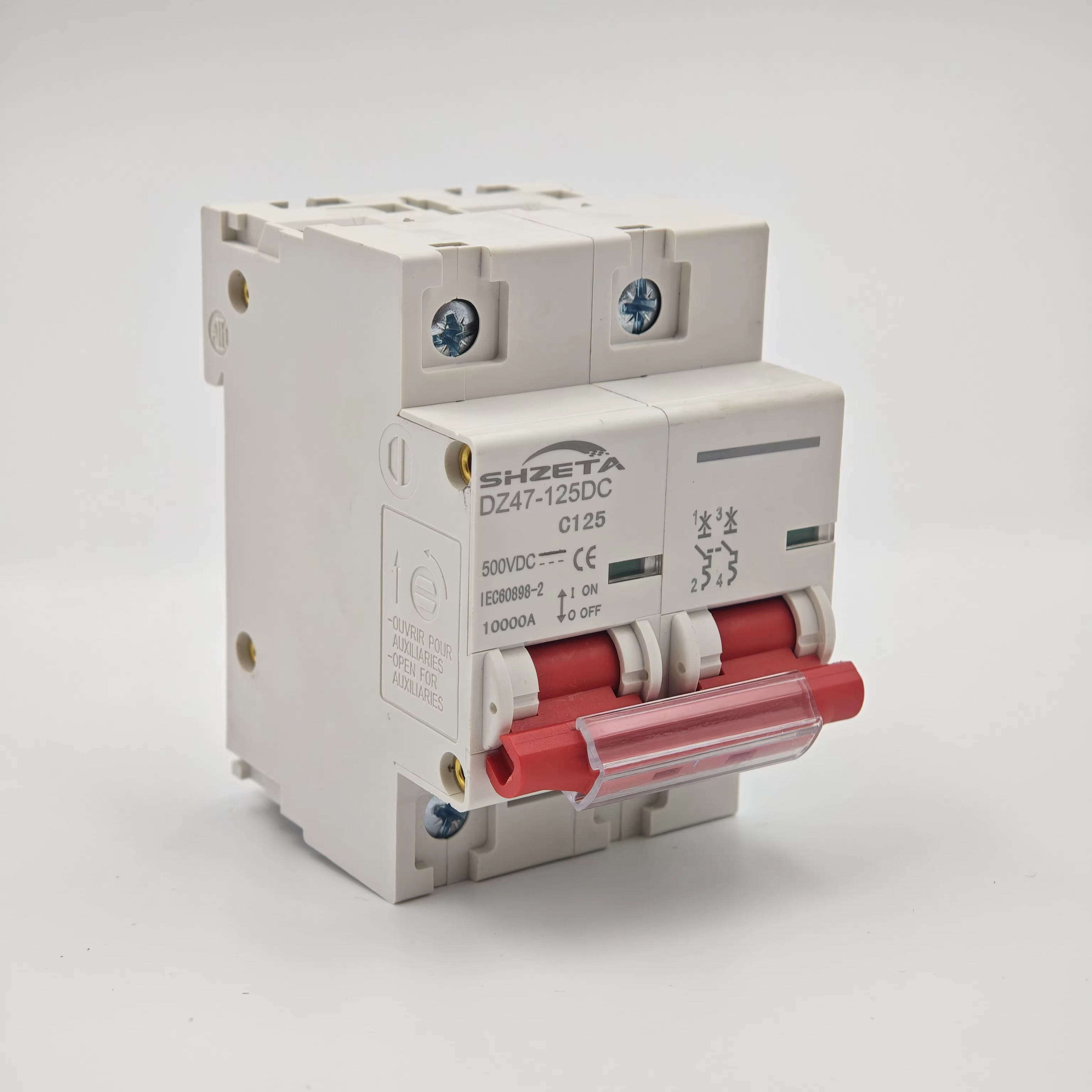
To interrupt 500V, 800V, 1000V, or 1500V DC currents, specialized DC MCCBs incorporate precision Lorentz force mechanisms. High-coercivity permanent magnets or electromagnetic blowout coils generate a transverse magnetic field perpendicular to the arc column. This forces the ionized plasma column to stretch outward at supersonic velocities, driving it deep into narrow insulated cooling chutes lined with de-ionizing metallic splitter plates where the arc voltage is forced higher than system voltage.
Bi-Directional Battery Protection
Modern Battery Energy Storage Systems (BESS) require bi-directional current interruption. During charging cycles, power flows from the bi-directional inverter to the lithium-ion rack; during grid injection, power flows in reverse. Modern DC MCCBs feature non-polarized arc suppression designs (utilizing symmetrical contact chutes and dual magnetic runners), preventing breaker destruction regardless of fault current polarity, essential for IEC 60947-2 compliance.
Top 10 DC MCCB Manufacturers & Global Factory Tiering (2025 Evaluation)
A rigorous engineering comparison of Tier-1 legacy giants versus agile high-capacity OEM factories in Wenzhou, China.
| Manufacturer / Factory | Primary Origin | Max Voltage Rating | Current Range (In) | BESS / Solar Suitability | Lead Time & OEM Flexibility |
|---|---|---|---|---|---|
| ABB (SACE Series) | Italy / Switzerland | 1500 VDC | 16A – 1600A | High (Utility Scale) | 12–20 Weeks; Strict catalog specs; Premium pricing |
| Schneider Electric | France | 1500 VDC | 16A – 1250A | High (Global EPC) | 10–18 Weeks; Limited custom housing / OEM modifications |
| Zhejiang Graybar Electric | Wenzhou, China | 1000V / 1500 VDC | 32A – 630A | High (Agile OEM) | 2–4 Weeks; Full OEM/ODM, Laser Logo, Custom Curve |
| Siemens (3VA) | Germany / Czechia | 1000 VDC | 16A – 630A | Medium-High | 14–22 Weeks; High engineering thresholds |
| Eaton (Power Defense) | United States | 1000V / 1500 VDC | 15A – 1200A | High (UL Grid) | 12–16 Weeks; Standardized procurement |
| Mitsubishi Electric | Japan | 1000 VDC | 32A – 800A | Medium | 10–16 Weeks; Strict Asian distribution tiering |
| CHINT Electrics | China | 1500 VDC | 25A – 1250A | High (Volume) | 6–10 Weeks; Higher MOQ barriers for customized runs |
| LS ELECTRIC | South Korea | 1500 VDC | 40A – 1600A | High (BESS) | 8–12 Weeks; Direct tier accounts prioritized |
| Terasaki Electric | Japan / UK | 1000 VDC | 16A – 1000A | Medium (Marine Focus) | 12–18 Weeks; Specialized marine distributor channels |
| Fuji Electric | Japan | 1000 VDC | 20A – 800A | Medium | 10–14 Weeks; Fixed model lineup |
Next-Generation Procurement & Architectural Trends in DC Circuit Protection
Strategic purchasing managers must calibrate their specifications to address the rapidly evolving requirements of renewable DC microgrids.
1. The Universal Transition from 1000V to 1500V Architectures
In both utility-scale solar photovoltaic arrays and centralized battery container systems, transitioning from 1000V DC to 1500V DC enables 50% longer string lengths, reduces combiner box quantities by up to 30%, and drastically cuts overall copper cable tonnage. However, at 1500V DC, break energy requirements increase exponentially ($E \propto V \cdot I \cdot t$). Future MCCB procurement demands multi-pole series cascading configurations (e.g., 3-pole or 4-pole in series) or dedicated single-pole heavy-duty vacuum-assisted arc interruption modules to achieve breaking capacities exceeding 35kA at 1500V.
2. Solid-State (SSCB) & Hybrid Breaker Evolution
Electromechanical contacts exhibit physical inertia, requiring 5 to 15 milliseconds to open during extreme short-circuit fault conditions. In lithium battery arrays, fault currents rise at tens of kiloamperes per microsecond. Leading manufacturers are investing heavily in hybrid DC MCCBs—combining silicon carbide (SiC) or IGBT solid-state switches that quench microsecond pulses with a galvanic air gap breaker in series. This delivers near-zero arcing, virtually eliminating contact erosion and explosion risks.
3. Integrated IoT Telemetry & Microsecond Fault Recording
Modern switchgear is no longer an isolated mechanical failsafe. EPCs and operations & maintenance (O&M) teams require continuous condition monitoring. Procured DC MCCBs are increasingly specified with built-in Hall effect sensors, internal temperature thermistors on primary terminals, and Modbus-RTU / CAN bus communication links. Real-time telemetry predicts thermal runaway at loose lug joints before catastrophic fires occur and logs trip curves for root-cause post-mortem analysis.
4. Stringent Non-Polarity & Environmental Sustainability
Historic DC circuit breakers relied on strict (+) and (-) marking; reversing wire entry caused explosive arc chute bypass. Current international tenders (IEC 60947-2 Annex P) mandate non-polarized operation across all DC MCCB ratings. Simultaneously, global buyers in the EU and North America require environmental compliance under RoHS, REACH, and cradle-to-gate carbon footprint verification, favoring factories with in-house thermo-plastic recycling and lead-free silver-tin-oxide (AgSnO2) contacts.
Why Global Buyers Partner with Zhejiang Graybar Electric
Located in Huangyu Village, Liushi Town, Wenzhou—the world's most concentrated low-voltage electrical capital—Zhejiang Graybar Electric Co., Ltd. provides international distributors, panel builders, and project contractors with the agility that massive conglomerates cannot match.
- End-to-End Vertical Supply Chain: Direct local access to high-purity electrolytic copper, silver-alloy stamping, and UL94 V-0 flame-retardant BMC/PBT tooling.
- Ultra-Low Minimum Order Quantities: Standard models start from 5 pieces (MCB, MCCB, SPD) and 1 piece for ACBs, enabling project testing and rapid prototyping without capital freeze.
- 100% Comprehensive Factory Inspection: Thermal-magnetic trip calibration, micro-ohmmeter contact resistance screening, and high-voltage dielectric flash testing for every production batch.
- Bespoke OEM/ODM Engineering: Complete private labeling, personalized laser engraving, custom tripping thresholds (B, C, D curves), and specialized international export packaging.
Frequently Asked Technical & Sourcing Questions (FAQ)
Direct engineering answers to common procurement questions regarding DC MCCB selection, IEC standards, and custom factory production.