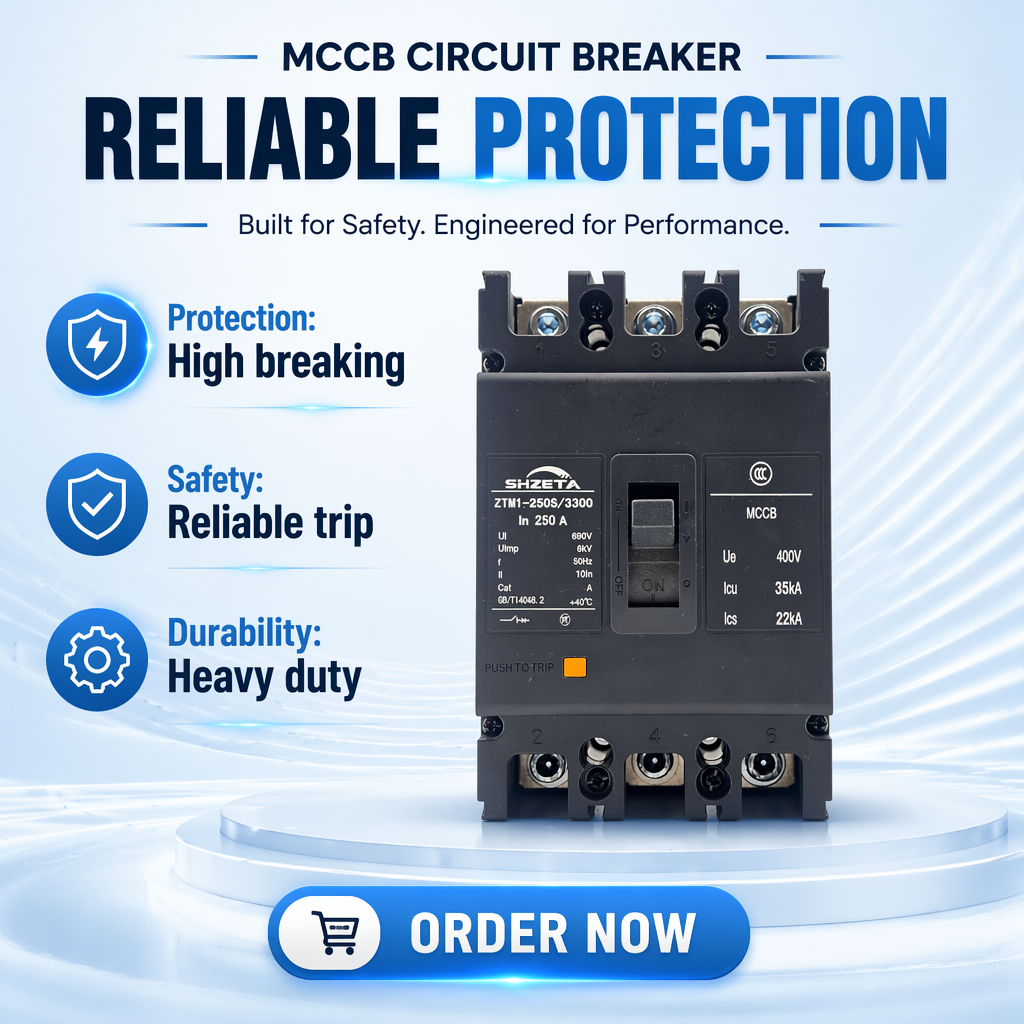
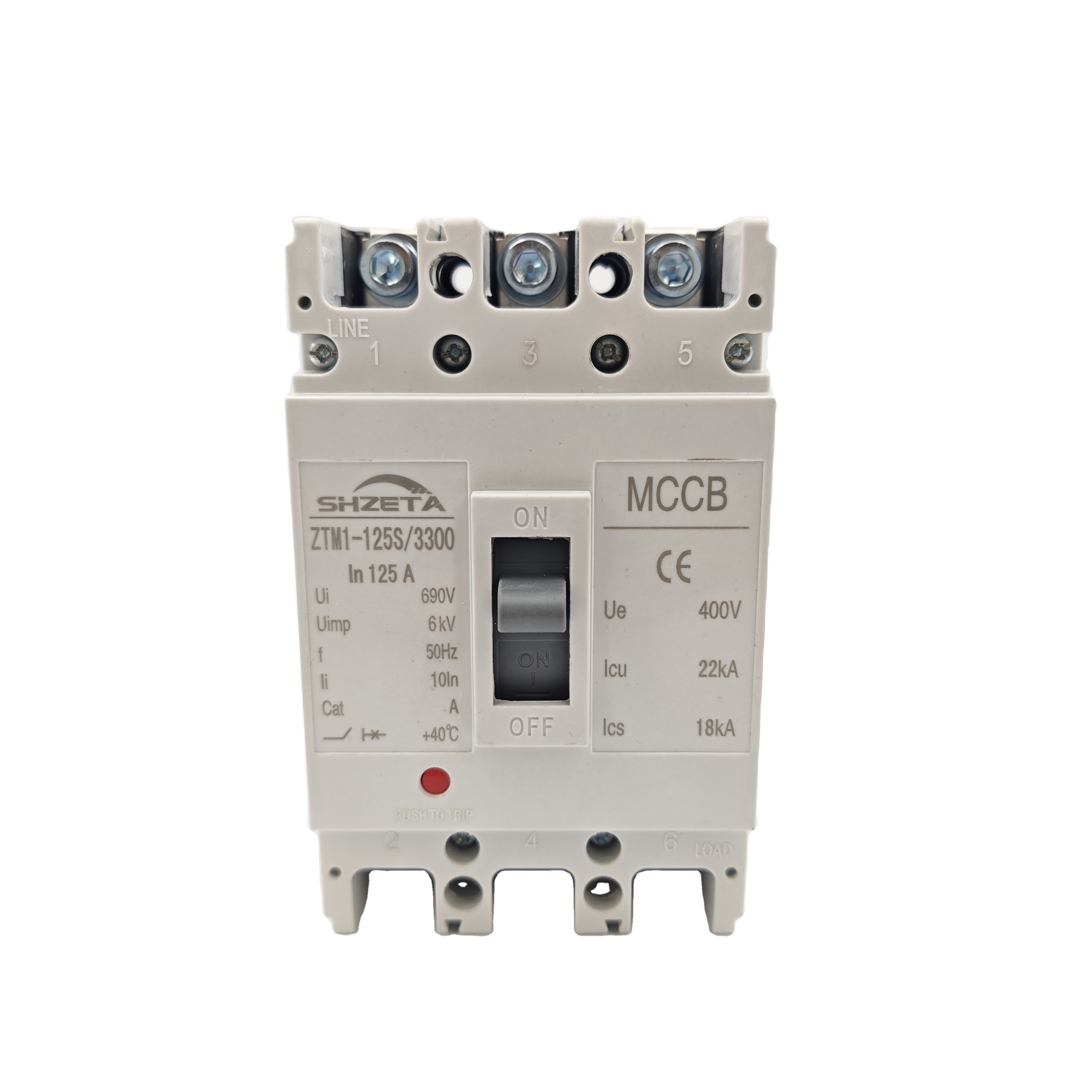
Thermal-Magnetic MCCB 50kA/100kA 400VAC/690VAC
- Capacity50kA / 100kA
- Voltage400VAC / 690VAC
- Trip UnitCopper & Plastic Bimetal
Explore production-grade Air Circuit Breakers, MCCBs, Contactors, and Dual-Power Transfer Switches manufactured in Liushi, Wenzhou for mission-critical power systems.
A comprehensive examination of Air Circuit Breakers (ACB) under IEC 60947-2 standards, thermal-magnetic coordination, and low-voltage substation switchgear protection.
Air Circuit Breakers (ACBs) serve as the cornerstone of electrical protection within low-voltage power distribution networks, primarily deployed on incoming transformer secondaries, high-capacity motor control centers (MCC), and critical generator synchronization buses. Unlike molded case circuit breakers (MCCBs) designed for modular branch circuits, industrial ACBs are engineered to withstand continuous primary currents ranging from 630A to 6300A while maintaining extreme short-time withstand current ratings (Icw).
The arc extinction medium in an ACB relies entirely on atmospheric air under controlled barometric conditions. When a short-circuit fault triggers breaker unlatching, separation of the main contacts generates an intense electrical arc consisting of ionized plasma reaching temperatures beyond 6,000 Kelvin. The arc is dynamically driven away from the stationary and moving silver-tungsten contact alloy surfaces via electromagnetic blowout coils and metallic splitter plates located inside the de-ionizing arc chutes (arc splitters).
Chinese air circuit breaker manufacturing hubs, particularly centered in Liushi, Wenzhou, have unified these mechanical arc-quenching kinematics with microcomputer-driven intelligent controllers. Contemporary production lines integrate precise coordinate calibration to guarantee that trip parameters such as Long Time Delay (L1), Short Time Delay (S), Instantaneous Pickup (I), and Ground Fault (G)—collectively known as LSIG protection—operate strictly within standardized tolerances of ±5% accuracy.
Specifying engineers face an architectural choice between Draw-out (Withdrawable) and Fixed-type ACB configurations. The selection impacts switchboard dimensions, operational reliability, capital expenditure, and plant downtime protocols during scheduled thermal inspections and contact renewals.
| Engineering Attribute | Draw-Out (Withdrawable) Execution | Fixed-Mount Execution |
|---|---|---|
| Mounting Base | Housed inside a stationary steel cradle; isolates via racking mechanism | Directly bolted to switchgear copper busbars and rear frame |
| Maintenance Safety | Provides visible air gap; tested in "Connected / Test / Disconnected" modes | Requires complete switchboard upstream de-energization |
| Downtime During Replacement | Under 15 minutes (swap chassis into pre-wired cradle) | 4 to 8 hours (mechanical disconnection of torque-sealed busbars) |
| Mechanical Complexity | Higher; features safety shutter mechanisms, interlocks, and primary clusters | Lower; minimal internal linkages, zero slide rails |
| Target Applications | Continuous process plants, data centers, hospitals, tier-3/4 power systems | Standalone generation skids, low-budget distribution boards, marine pump skids |
In modern industrial facilities requiring uncompromised uptime, draw-out air circuit breakers dominate over 80% of wholesale orders. The internal carriage enables technicians to rack the unit into a "Test" position, verifying shunt releases, under-voltage coils, and auxiliary relay sequences without exposing personnel to live 400V/690V busbar stabs. Safety shutters automatically lower to shield stationary jaw assemblies whenever the breaker chassis is rolled out onto switchboard maintenance guide rails.
The global procurement market for air circuit breakers is experiencing a structural shift accelerated by industrial electrification, microgrid adoption, and decentralized solar photovoltaic installations. Key industry trajectories include:
A. Microprocessor Intelligence & Native Edge Telemetry: Conventional thermal-bimetal sensing has been completely phased out in high-amperage breakers. Smart ACBs now integrate embedded 32-bit ARM microprocessors capable of real-time True RMS power analysis, harmonic distortion profiling up to the 31st harmonic, and predictive contact wear monitoring based on cumulative interrupted fault energy (ΣI²t). With native support for Modbus-RTU, Profibus-DP, and Ethernet IEC 61850 protocols, smart ACBs connect directly to building automation systems without external transducers.
B. Renewable DC Infrastructure & Bidirectional Flow: High-capacity commercial solar parks, battery energy storage systems (BESS), and EV supercharger hubs necessitate low-voltage ACBs capable of managing variable frequencies and bidirectional fault feeds. Unlike unidirectional grid transformers where faults emerge strictly downstream, distributed generation introduces multi-source short-circuit loops. Modern ACBs engineered in China feature bidirectional arc splitters and dynamic directional trip logic (D-Curve Protection) to protect both generator sources and inverter arrays.
C. Supply Chain Regionalization & Wenzhou Manufacturing Dominance: As European and North American distributors face inflationary pressures and lead times exceeding 26 weeks from legacy brands, Tier-1 Chinese manufacturers provide a resilient alternative. Zhejiang Graybar Electric has optimized the balance between standardized component economies of scale and customized OEM/ODM agility, offering fully certified frames with lead times maintained under 3 to 4 weeks.
Operating from Huangyu Village, Liushi Town, Wenzhou—the global epicenter of low-voltage electrical apparatus—we unify high-precision fabrication, certified laboratory testing, and turnkey export logistics.
Direct supply-chain integration in Liushi. In-house injection molding of BMC thermo-resistant housings, stamping of high-purity silver-alloy contacts, and automated coil winding eliminate intermediary markups.
Every single circuit breaker undergoes rigorous factory acceptance checks: dielectric insulation testing at 2500V, mechanical operating endurance, and secondary injection calibration across all LSIG curves.
Lower initial testing barriers with low MOQs: start with 1 unit on complex Air Circuit Breakers and 5 units on standard MCCB, ATS, and SPD lines to validate performance prior to full container bookings.
Tailored front fascia designs, private label laser etching, multilingual schematic printings, custom secondary terminal configurations, and customized carton packaging engineered for global distribution.
Practical engineering answers addressing breaking capacities, coordination, delivery protocols, and OEM compliance for professional electrical importers.
Under IEC 60947-2, Icu represents the Ultimate Short-Circuit Breaking Capacity (the maximum current a breaker can interrupt twice), whereas Ics represents the Service Breaking Capacity. An ACB certified at 100% Icu can clear a catastrophic short circuit, re-close, and continue to safely carry its rated operational current without degradation of internal contacts or melting of arc runner assemblies.
During routine batch testing, each ACB is subjected to continuous rated current injection to verify terminal junction temperatures against IEC limits (maximum permissible rise ≤ 70K). Contact resistance across primary disconnect fingers and main vacuum or air contacts is measured in micro-ohms (μΩ) via digital micro-ohmmeters to prevent thermal runaway in enclosed switchboard cubicles.
Yes. Our intelligent universal trip controllers support plug-and-play communication modules including Modbus-RTU, Profibus-DP, and native Ethernet/IP. Engineers can remotely execute trip commands, adjust curve coordinates, and retrieve historical trip event logs including recorded fault current waveforms.
Coordination relies on Short-Time Withstand Current (Icw) capability. The upstream ACB employs an intentional short-time delay (e.g., 0.1 to 0.4 seconds) during a localized fault, allowing the immediate downstream Molded Case Circuit Breaker (MCCB) to trip without blacking out the entire facility—a principle known as total discrimination or selectivity.
Zhejiang Graybar Electric provides accredited third-party factory inspection reports, ISO9001 management certifications, and complete IEC type-test reports covering breaking performance, temperature rise, mechanical operations, and dielectric withstand for all ACB frame sizes.
Standard frame sizes (630A to 3200A) are typically manufactured within 15 to 25 business days. Heavy draw-out breakers are packed inside shock-absorbing, export-grade plywood crates with moisture barrier desiccant bags, securely palletized to endure rigorous containerized ocean handling.