Featured Automatic Transfer Switches & Metering Series
Explore our primary selection of low-voltage transfer switching devices, manual changeover circuit breakers, and Modbus-enabled telemetry meters precision-manufactured for international OEM panel builders and power contractors.
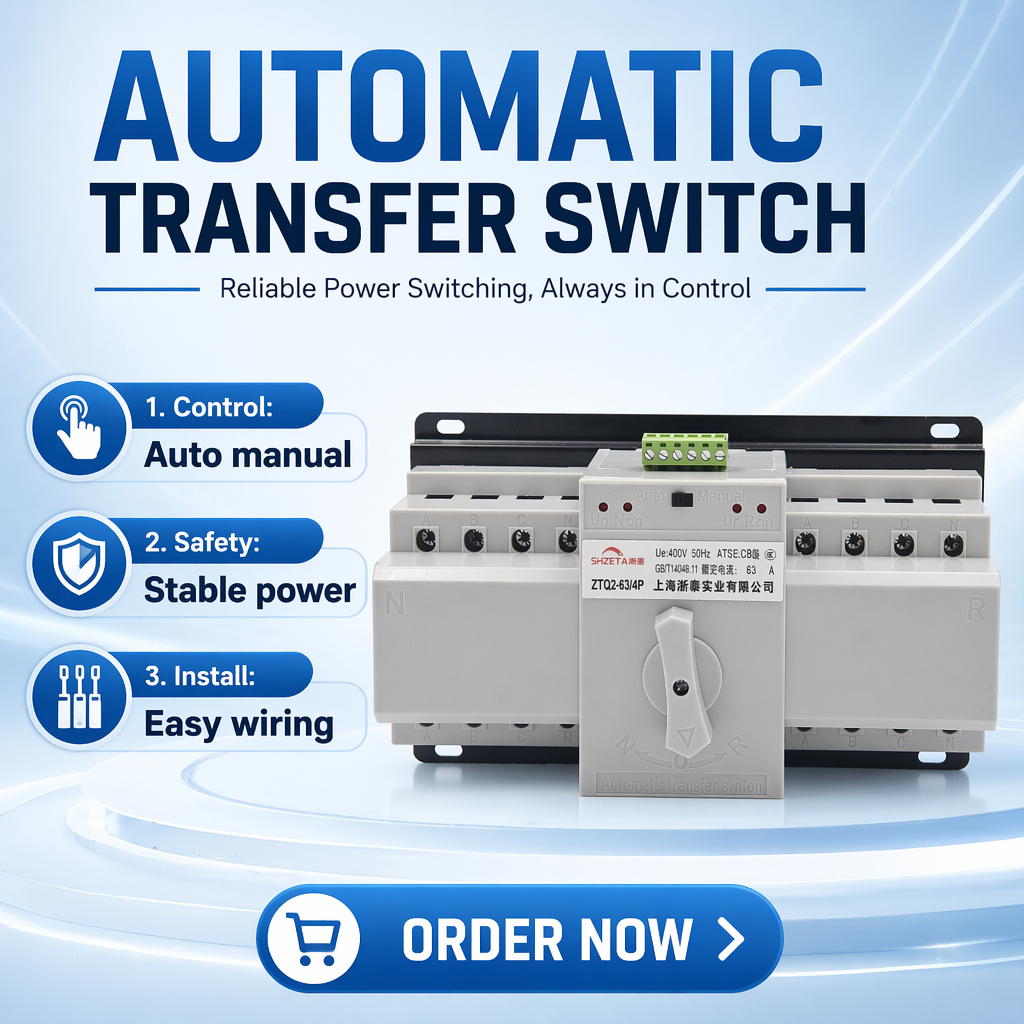
ATS PC Three Phase 4P 63A 400V 5kA Dual Power Automatic Changeover
- Switching ClassPC Class (Power Contact)
- Rated Operational Current63A (AC-33B)
- Breaking Capacity5kA at 400V AC
- ApplicationDual Power / Solar Hybrid
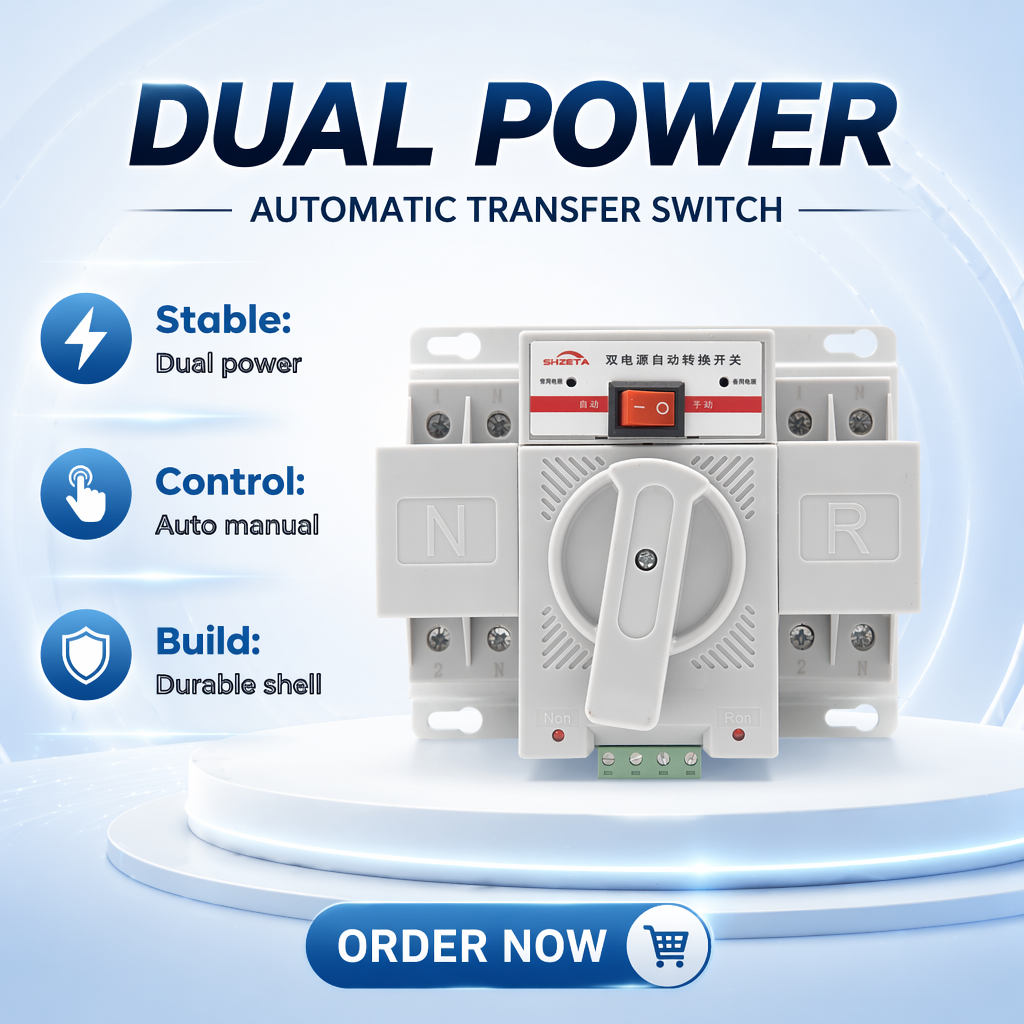
4P 63A Single Phase Manual Changeover Switch Transfer with Breaker Type ATS
- Switching ClassCB Class Integrated
- Pole Configuration4 Pole (3P+N Isolation)
- Rated Current63A Continuous
- ProtectionOverload + Short-Circuit
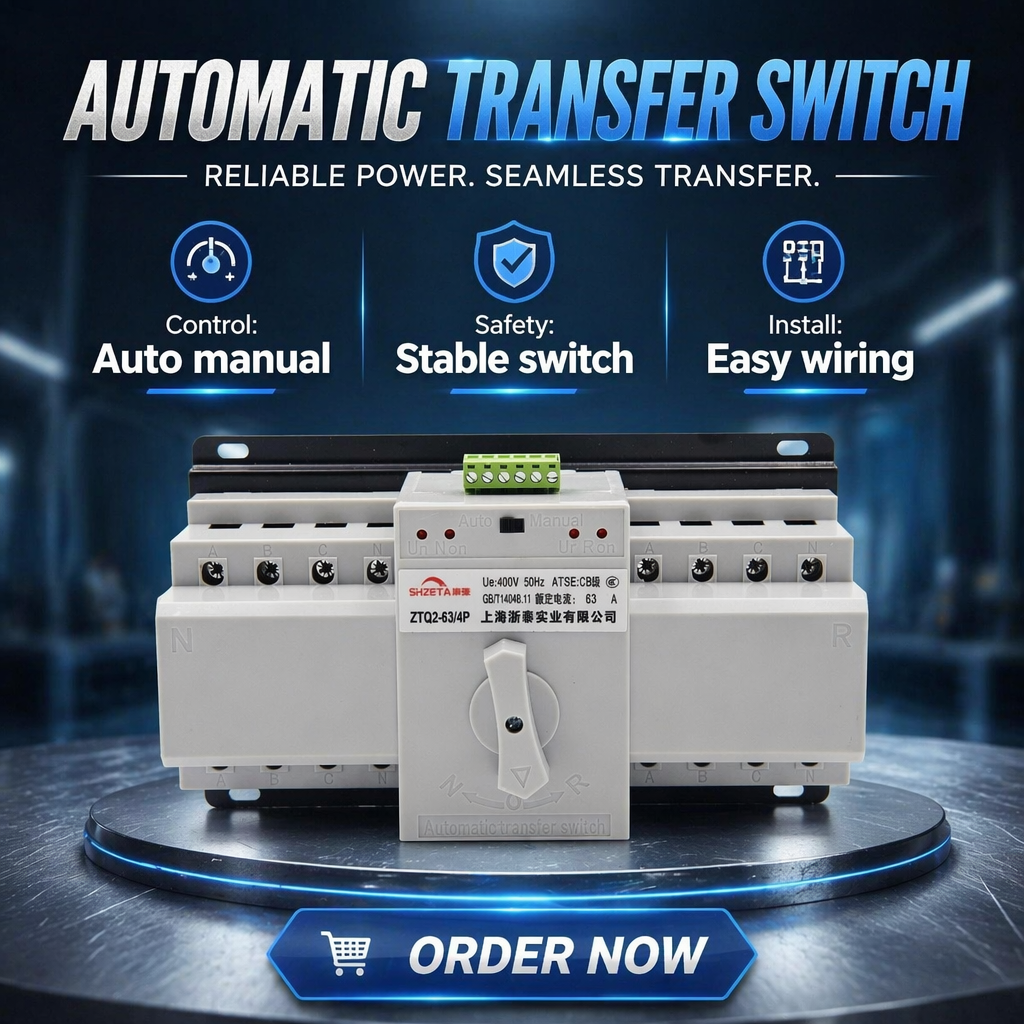
4P 63A Manual Changeover Switch Reliable Dual Power Transfer Circuit Breaker
- MechanismMechanical Interlock Lever
- Rated VoltageAC 230V / 400V
- MountingStandard 35mm DIN Rail
- ApplicationHome & Light Industrial
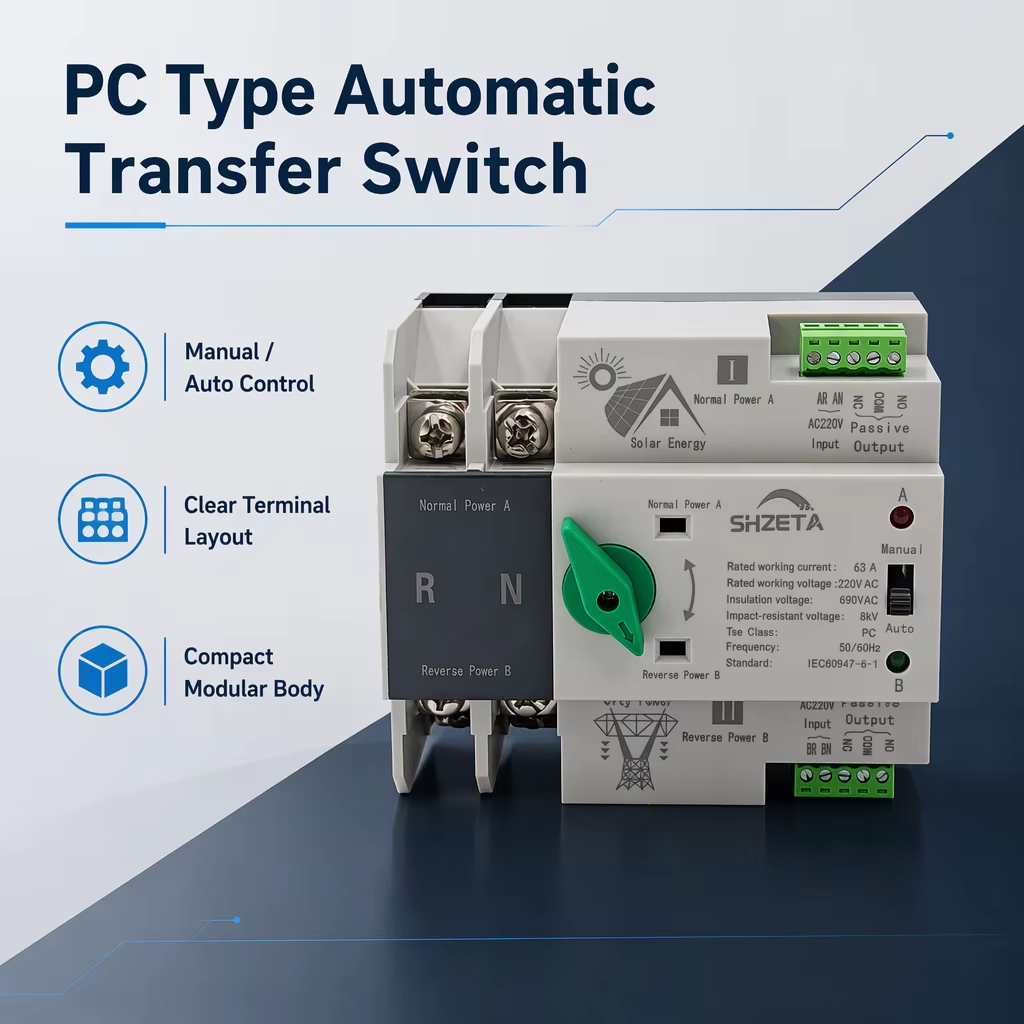
PC Type Automatic Transfer Switch 220V AC Manual Auto Modular Changeover
- Operational Voltage220V AC Single Phase
- Control ModeAuto Transfer & Manual Toggle
- Switching Speed< 50 ms Fast Action
- Target SystemSolar Photovoltaic Inverter
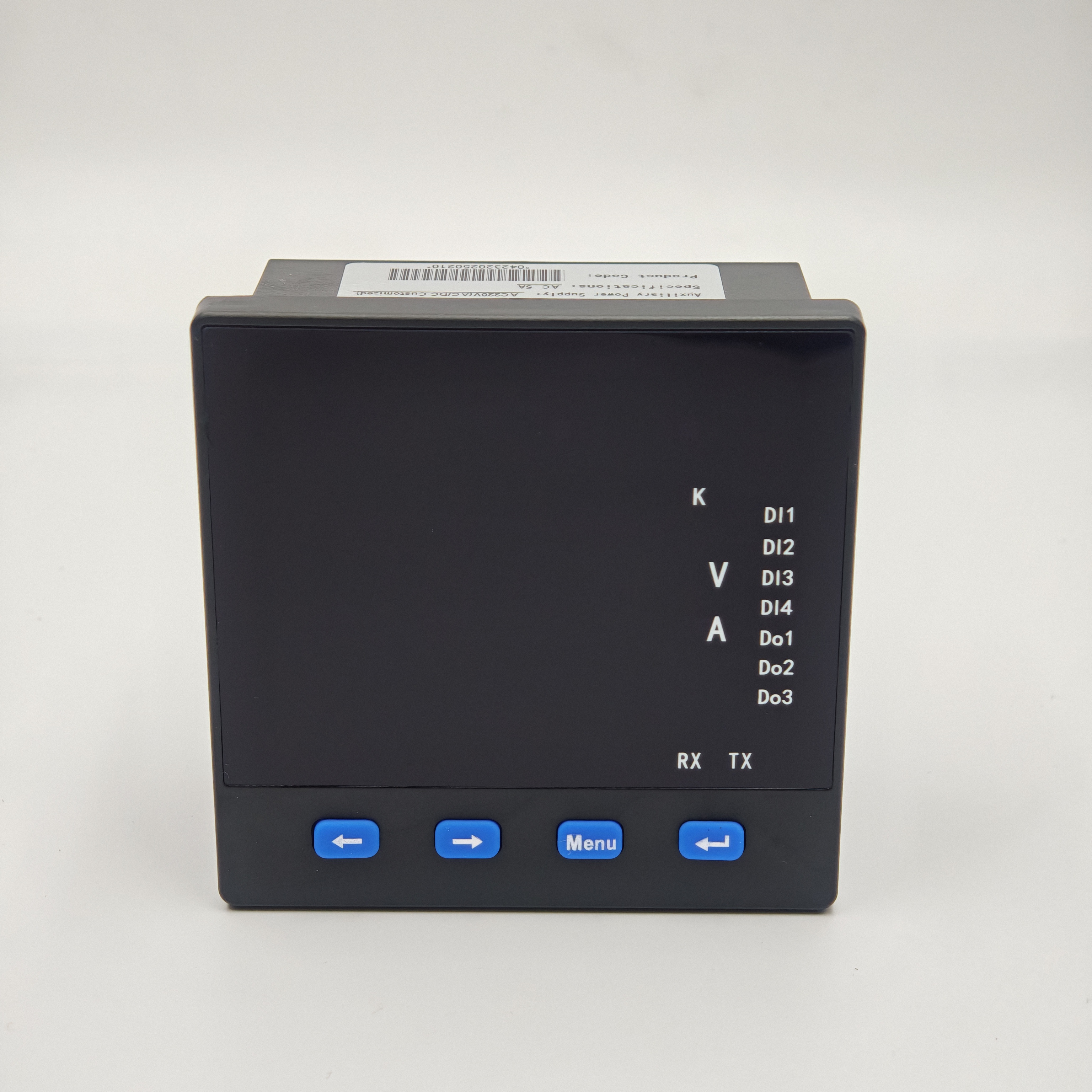
ZTDSI HY-311-80VY Series 0.5 Class 3-Phase Energy Meter RS485/Modbus
- Accuracy ClassClass 0.5 Energy Metering
- Voltage RangeAC/DC 60V ~ 280V
- InterfaceRS485 Modbus-RTU Protocol
- FunctionATS Synchronization Telemetry

Din Rail ATS Double Power Transfer Switch 4P 100A 125A Three Phase PC Type
- Rated Amperage100A / 125A Selectable
- Voltage Rating400V AC 50/60Hz
- StructurePC Type Dual Solenoid Drive
- ServiceOEM Laser Label & Packaging
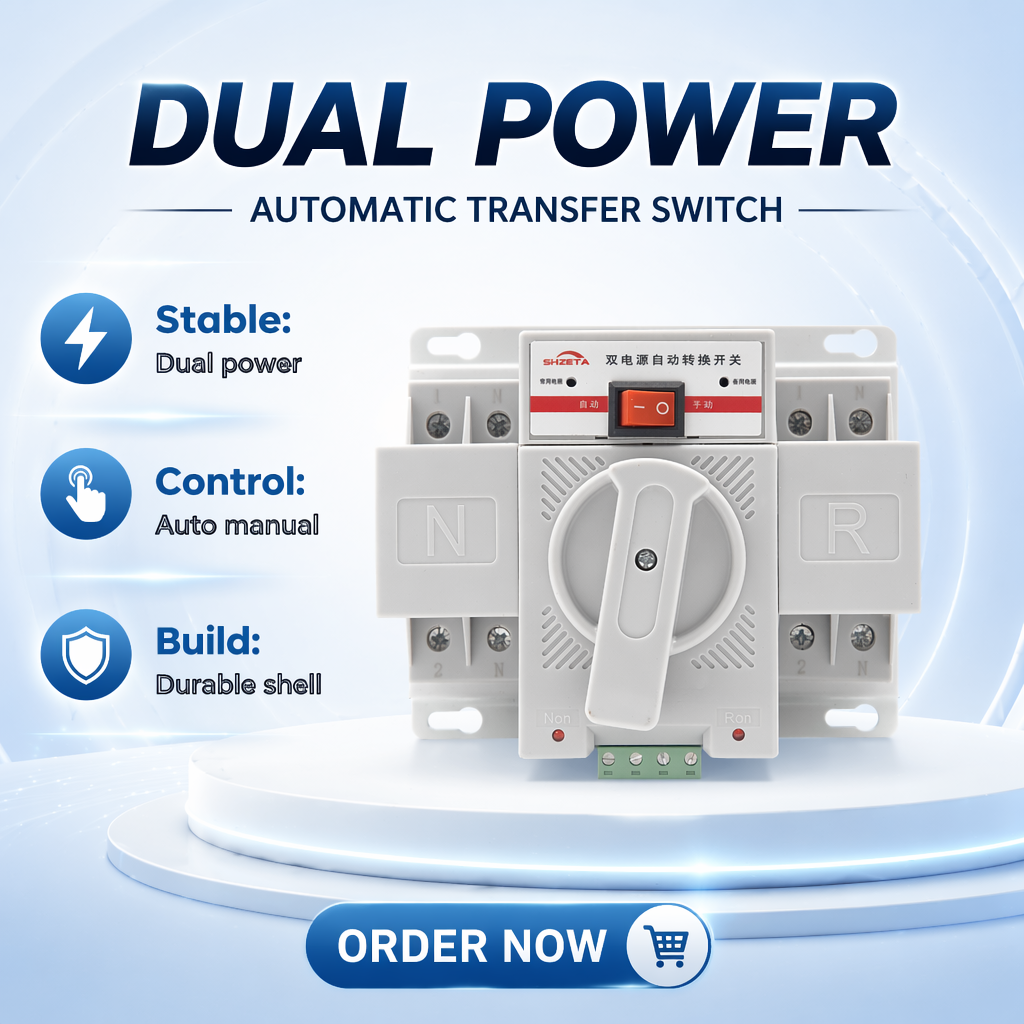
Din Rail 2P ATS Dual Power Automatic Transfer Switch 63A 230V 3kA Household
- Poles2-Pole (Live + Neutral)
- Rated Current63A at 230V AC
- Breaking Capacity3kA Compact Envelope
- FunctionUninterrupted Home EPS/UPS
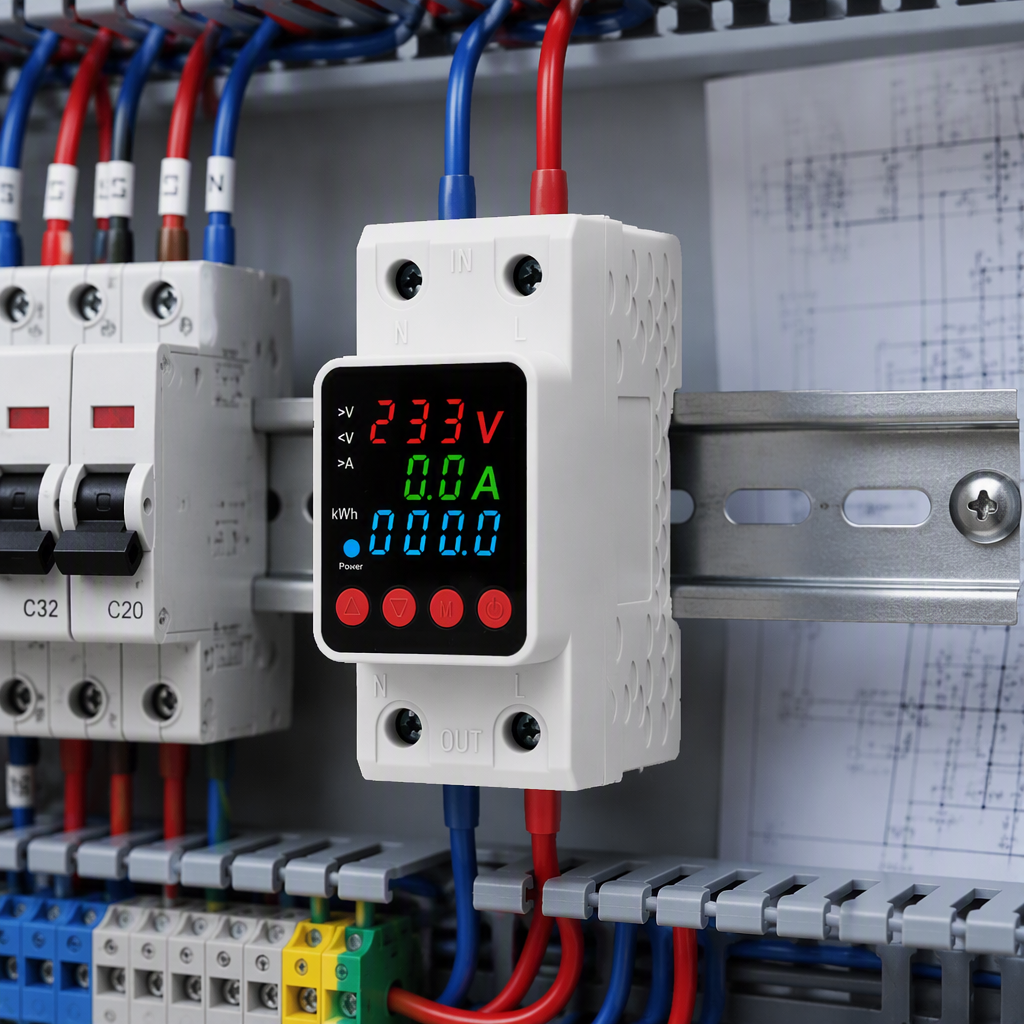
SHZETA Single Phase AC Voltage Meter with Over-Voltage Protection & kWh Display
- Line MonitoringUnder/Over-Voltage Threshold
- MeteringDigital Display Real-time kWh
- CoordinationATS Line Monitoring Auxiliary
- EnclosureFlame Retardant DIN Module
Executive Technical Treatise: Automatic Transfer Switching Equipment (ATSE) Architecture
In low-voltage distribution topologies conforming to IEC 60947-6-1 and GB/T 14048.11, Automatic Transfer Switching Equipment (ATSE) serves as the primary safeguard for operational continuity. The fundamental mission of an ATS is not merely toggling between a normal power source (utility grid) and an alternate power source (diesel generator or solar PV/energy storage system), but guaranteeing safe galvanic separation under both steady-state operating currents and abnormal short-circuit conditions.
PC Class (Power Contact) ATSE: Built with dedicated high-speed electromagnetic or motorized contact assemblies, PC-class switches are capable of making, carrying, and withstanding rated currents and short-circuit currents. Crucially, PC-class transfer switches do not incorporate integral thermal-magnetic overcurrent trip units. They prioritize continuous circuit availability and rely on upstream circuit breakers or fuses for fault interruption. This architecture guarantees that the contact system will not trip open mid-transfer, achieving high rated short-time withstand currents ($I_{cw}$) and rated short-circuit making capacities ($I_{cm}$).
CB Class (Circuit Breaker) ATSE: Constructed from two mechanically interlocked circuit breakers (MCBs or MCCBs) driven by an external motorized or solenoid actuator. The integral trip mechanisms provide automatic overload and short-circuit clearance. However, should a downstream transient overcurrent occur during transfer, a CB-class ATS might trip internally, isolating both the normal and reserve sources simultaneously and requiring manual technician intervention to reset the tripped breaker mechanism.
| Evaluation Parameter | PC-Class (Power Contact) | CB-Class (Circuit Breaker) | CC-Class (Contactor Type) |
|---|---|---|---|
| Primary Standard | IEC 60947-6-1 | IEC 60947-6-1 / IEC 60947-2 | IEC 60947-6-1 / IEC 60947-4-1 |
| Integral Trip Unit | None (High Continuity) | Yes (Thermal/Magnetic) | None (Aux Relay Optional) |
| Short-Time Withstand ($I_{cw}$) | High (Up to 100kA / 60ms) | Moderate (Bounded by Trip Curve) | Low to Moderate |
| Transfer Speed ($t_t$) | < 30 ms to 80 ms | 100 ms to 350 ms | 50 ms to 150 ms |
| Arc Chute Efficiency | Heavy Duty Multi-Plate Grid | Standard Breaker Arc Chute | Standard De-ionizing Grid |
| Contact Metallurgy | Silver Tin Oxide ($AgSnO_2$) Micro-Alloy | Silver Nickel ($AgNi$) / Tungsten | Fine Silver / Copper Composite |
| Prime Application Fields | Data Centers, Hospitals, Solar ESS | Commercial Feeders, Sub-Panels | HVAC, Motor Transfer, Lighting |
For engineering procurement teams, understanding the operational transfer duty cycle (Utilization Category AC-33B for mixed resistive and inductive motor loads, vs AC-31B for non-inductive resistive loads) determines whether a switch can survive inrush motor currents exceeding six times nominal full-load amperage without contact micro-welding or contact erosion.
Future Procurement Trends in Low-Voltage Transfer Switching
Global commercial tenders are evolving rapidly. Discover how renewable microgrid convergence, smart grid IoT standards, and rigorous harmonic neutral isolation are transforming global ATS procurement specifications.
Hybrid Solar PV & BESS Integration
Procurement specifications now mandate bidirectional fast-acting ATS capable of seamlessly shuttling power between solar photovoltaic inverters, battery energy storage systems (BESS), and diesel gensets with zero phase backfeed.
RS485 Modbus Telemetry & Edge IoT
Legacy dry-contact status relays are yielding to embedded microprocessors with RS485 Modbus-RTU and Ethernet telemetry. Remote operators monitor line voltages, harmonic distortion, contact wear index, and transfer cycle logs in real time.
Switched Neutral & Harmonic Protection
Non-linear inverter loads induce elevated third-harmonic currents ($I_{3h}$) in neutral lines. Global EPC tenders universally demand true 4-Pole (4P) switched neutrals with overlapping neutral contacts to prevent dangerous floating ground voltages during transitions.
Eco-Friendly Cadmium-Free Metallurgy
Complying with RoHS and European Union REACH regulations, leading Chinese exporters are standardizing on silver tin oxide ($AgSnO_2$) and silver indium oxide matrices, eliminating hazardous silver cadmium ($AgCdO$) without sacrificing arc-erosion durability.
Technological Evolution: Smart Dual-Source Synchronization Dynamics
The historical drawback of conventional mechanical changeover switches was their susceptibility to uncontrolled transfer during non-synchronized voltage phase angles. When an ATS switches inductive loads—such as three-phase asynchronous motors or distribution transformers—from an out-of-phase utility source to a standby diesel generator, an instantaneous out-of-phase reclosing spike occurs. This generates inrush currents up to 15 to 20 times normal rated current, causing sheared mechanical motor shafts, blown upstream fuses, and cracked switchgear housings.
To overcome this, modern Chinese ATS manufacturing integrates three innovative architectural advancements:
In-Phase Monitor Logic
Microprocessor controllers calculate relative frequency and voltage vector difference ($\Delta V$ & $\Delta f$). The transfer command fires solely when both sources converge within a safe electrical synchronization window of ±5 electrical degrees.
Delayed Transition with Zero Center-Off
For un-synchronized systems, the mechanism features an engineered programmatic delay in the center neutral "OFF" position. This allows trapped counter-electromotive force (CEMF) inside spinning motors to decay safely to negligible levels before connection to source B.
Self-Cleaning Knife-Action Silver Contacts
Utilizing patented sliding wiping action upon engagement, incoming electrical contacts clear transient oxidation and micro-carbon films with every actuation, keeping internal contact millivolt drop below 3.2 mV even after 5,000 cycles.
These engineering refinements guarantee seamless continuity for commercial enterprise applications, telecommunication base stations, intensive care medical suites, and automated process industrial assemblies.
Why Global Buyers Partner with Zhejiang Graybar Electric
Direct from Liushi Town, Wenzhou—the world epicenter of low-voltage electrical apparatus—Zhejiang Graybar Electric Co., Ltd. combines agile manufacturing, localized supply chain integration, and rigorous quality assurance.
Unrivaled Supply Chain Depth in China's Electrical Capital
Headquartered in Huangyu Village, Liushi Town, Yueqing, Zhejiang Graybar Electric Co., Ltd. operates in the epicenter of the global low-voltage circuit protection supply chain. Our industrial proximity allows raw materials—including high-conductivity electrolytic copper alloys, UL94 V-0 flame-retardant polyamide polymers, and precision bimetal strips—to be sourced, verified, and placed on assembly lines within hours.
Unlike pure trading agents, we provide verified industrial accountability:
- Full-Scope In-House Testing: Dielectric withstand tests at 2,500V, temperature rise evaluations at rated load, and precision millisecond timing oscilloscopes ensure zero out-of-spec units leave our docks.
- Flexible Low MOQs: Modular DIN-rail ATS units begin at an accessible 5-piece sample threshold, and heavy-duty frame units start from 1 piece to allow thorough prototype validation.
- Comprehensive OEM/ODM Engineering: Complete customization of operational trip curves, private label laser engraving, tailored coil voltages (12V, 24V, 110V, 230V, 400V), and localized multilingual manuals.
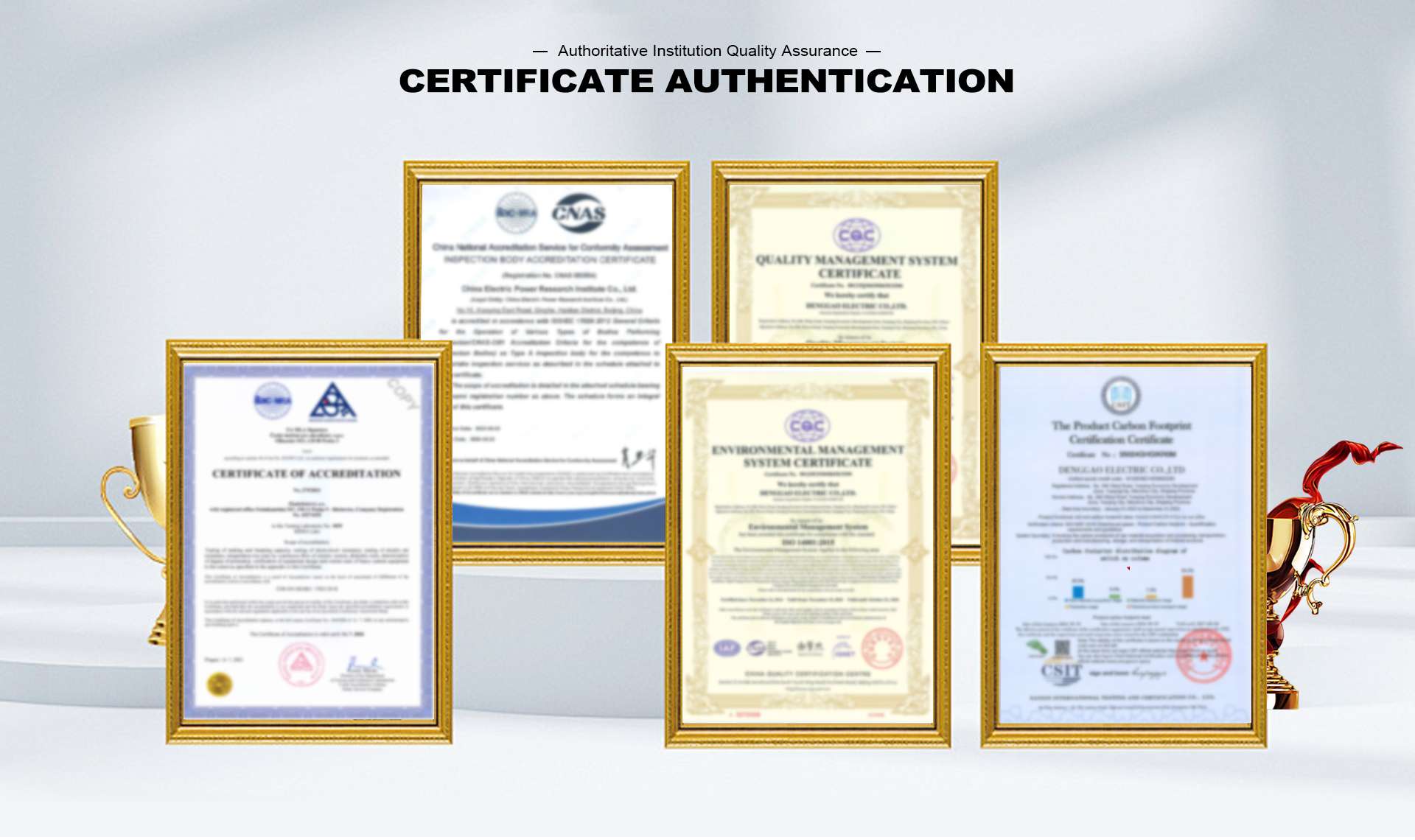
- Independent Factory Verification: Our facilities undergo strict on-site audits, offering transparent transaction levels, verified export records, and clear legal certifications.
Frequently Asked Technical & Sourcing Questions
Comprehensive answers to the most critical technical and commercial questions submitted by electrical switchboard builders, EPC project managers, and international equipment importers.
How does an engineer select between 3-Pole (3P) and 4-Pole (4P) ATS configurations?
What is the crucial difference between Rated Short-Time Withstand Current (Icw) and Conditional Short-Circuit Current?
Can standard PC-Type ATS units handle solar PV inverters and grid-tied energy storage switching?
What are the factory testing and quality verification procedures executed before shipment?
What is the standard lead time, MOQ, and export shipping packaging for overseas containers?
Do you support OEM private branding, custom voltage coils, and bespoke laser labeling?
Request Engineering Quotes & Comprehensive Technical Catalogs
Partner directly with a verified China manufacturer in Liushi, Wenzhou. Connect immediately with our senior power distribution sales engineers to submit your Bill of Materials (BOM), request customized sample units, or schedule an online factory tour.