Global buyers are entering 2026 with more demanding electrical protection requirements. The International Energy Agency’s Electricity 2024 report projects global electricity demand to grow by an average of 4% annually through 2026. More loads mean more protection decisions.
A Miniature Circuit Breaker is no longer a simple catalog item. It must match the circuit’s voltage, current, fault level, installation environment, and connected equipment. IEC 60898-1 remains a key reference for household and similar installations, while IEC 60947-2 applies to broader industrial switching and protection equipment. These standards help buyers compare performance, but they do not remove the need for engineering judgment.
Small details matter. A Type B curve may suit lighting and resistive loads. Type C can better tolerate moderate motor inrush. Type D is intended for higher starting currents, such as transformers or industrial motors. AC, DC, single-pole, two-pole, and four-pole designs each create different selection questions. Breaking capacity also deserves close attention, especially in commercial buildings with higher prospective fault currents.
There is no universal best type.
That assumption needs challenging.
This 2026 guide compares the main Miniature Circuit Breaker types for international purchasing teams. It considers trip curves, poles, rated current, breaking capacity, temperature effects, certification, and application fit. It also draws on IEC standards and IEA market data, rather than relying only on supplier descriptions. Some product labels appear similar across regions, yet their testing conditions may differ. Buyers should verify current certificates, test reports, and installation requirements before approval. A cheaper breaker can become expensive when nuisance tripping, poor coordination, or unsuitable fault protection disrupts a real facility.
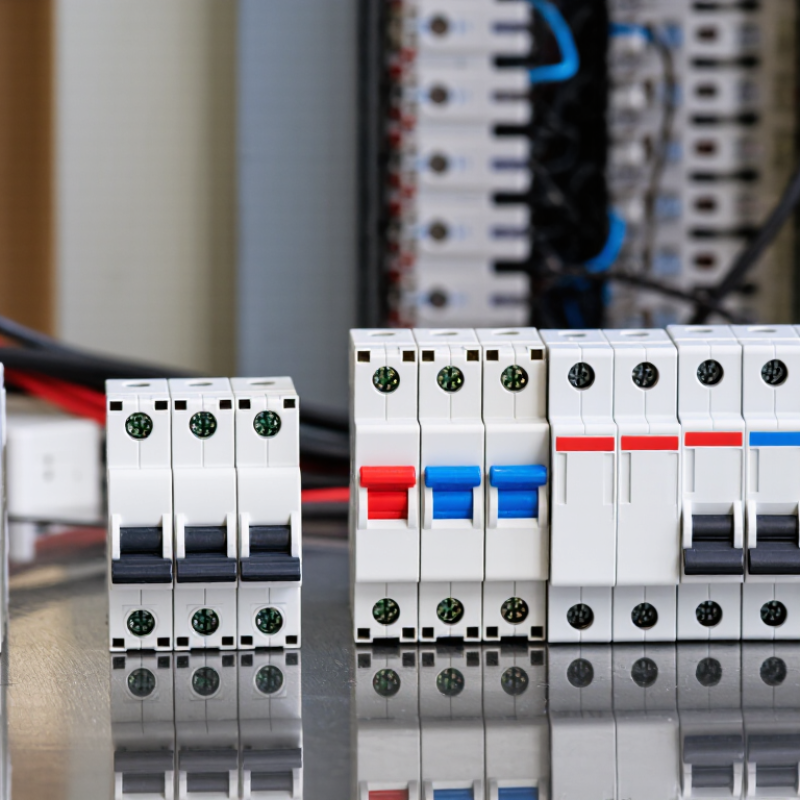
A miniature circuit breaker (MCB) is a resettable safety device for low-voltage electrical circuits. It disconnects power when current becomes dangerously high. Unlike a fuse, it does not need replacement after every trip. Inside the compact enclosure, thermal and magnetic mechanisms work together. The thermal element responds to sustained overloads. The magnetic element reacts almost instantly to short circuits. That difference matters. Small device. Serious protection.
During an overload, a bimetal strip heats, bends, and releases the switching mechanism. For a short circuit, a magnetic coil creates a strong pull and opens the contacts quickly.
The separated contacts produce an arc, which an internal arc chamber helps cool and divide.
After the fault is removed, the lever can usually be reset manually. A visible trip position helps technicians identify the interruption, although it is not always perfectly clear.
Global buyers should check pole count, rated current, voltage, tripping curve, and breaking capacity. Common curve options include B, C, and D, but selection depends on equipment starting current and local practice.
Single-pole units protect one live conductor; two-pole units can disconnect two conductors together. The rated value must match the cable and circuit design, not only the appliance label.
A common mistake is choosing a higher rating to prevent nuisance trips. That can weaken protection.
Verify installation requirements with a qualified electrician and the applicable regional standard.
Thermal-magnetic MCBs remain practical for homes, offices, and small commercial panels. Their thermal element responds to sustained overloads, while the magnetic element reacts to short circuits. A B-curve device often suits lighting and general socket circuits. A C-curve type handles moderate starting currents from pumps, fans, and small motors. D-curve protection is intended for equipment with high inrush currents, but it needs careful fault-loop verification.
Single-pole MCBs commonly protect individual single-phase conductors. Two-pole versions disconnect both live and neutral where local installation practice requires it. Three-pole and four-pole designs fit industrial three-phase systems, such as machine tools and distribution boards. Direct-current MCBs are different. Their arc-control design must match the voltage and polarity of solar storage, control, or battery circuits. An AC model should not be substituted casually.
Electronic MCBs can provide more adjustable protection and improved monitoring for sensitive installations. However, they may cost more and require clearer commissioning records. An RCBO combines overcurrent protection with residual-current protection, making it useful for bathrooms, outdoor sockets, and circuits near water. It is not identical to an MCB. Buyers should check rated current, breaking capacity, pole configuration, trip curve, terminal size, temperature limits, and applicable regional standards.
In field reviews, the trip curve is often selected correctly, but the available short-circuit current is overlooked. That mistake deserves more attention.
Choosing an MCB starts with the circuit, not the product label. Pole count must match the supply arrangement and isolation requirement. A single-pole device usually protects one phase. A two-pole device can disconnect phase and neutral together. Three-phase systems may require three or four poles, depending on the neutral design and local rules.
Tripping curves describe how quickly an MCB responds to high inrush current. Curve B typically trips magnetically at 3–5 times rated current. Curve C usually trips at 5–10 times. Curve D may tolerate 10–20 times, making it suitable for motors or transformers with strong starting surges. Do not select Curve D casually. It may delay fault disconnection if the loop impedance is too high. That detail is easy to miss.
Breaking capacity is equally important. Compare the MCB rating with the prospective short-circuit current at the installation point. A 6 kA device may be unsuitable where the available fault current reaches 8 kA. Select a capacity equal to or above that calculated value, following IEC 60898-1 and applicable national requirements. Thermal loading, cable size, ambient temperature, and enclosure ventilation also affect reliability. A higher breaking capacity does not automatically improve protection. It only withstands a larger fault current. Field assessments often expose imperfect assumptions, so confirm calculations before approval.
Global MCB selection in 2026 starts with the installation standard, not the lowest purchase price. The IEA Electricity 2024 report projects average global electricity-demand growth of 3.4% annually through 2026. IRENA’s Renewable Capacity Statistics 2025 records 585 GW of renewable capacity added in 2024. These figures suggest more distributed circuits, bidirectional loads, and mixed operating conditions. They do not justify one universal MCB.
For household and similar AC applications, IEC 60898-1 covers MCBs up to 440 V, 125 A, and 25 kA short-circuit capacity. Industrial buyers should assess IEC 60947-2, while North American projects commonly require ANSI/UL 489 evaluation. Check the adopted national edition. A certificate alone is insufficient. Verify Icn or Icu against the prospective short-circuit current at the panel. B, C, or D curves must match inrush, cable capacity, and disconnection time. A 6 kA device is unacceptable where calculated fault current reaches 10 kA.
Inspect conductor size, ambient correction, altitude, enclosure heat, terminal torque, and upstream-downstream selectivity. Field inspections repeatedly show that loose terminations can defeat a compliant device. This is often missed. The tested combination matters when backup protection or cascading is claimed. Request type-test evidence, calibration records, and a traceable lot number. My caution is imperfect: catalog curves rarely represent a hot, crowded enclosure. Recalculate for the actual site, then obtain qualified engineering verification.
Global Standards and Safety Requirements for MCB Selection
The chart shows the instantaneous magnetic tripping ranges defined for common MCB characteristics under IEC 60898-1. Type B is generally used for circuits with low inrush current, Type C for moderate inrush loads, and Type D for equipment with high starting currents. Final selection should also verify rated current, system voltage, interrupting capacity, pole configuration, ambient temperature, and the applicable national or regional standard.
Reference basis: IEC 60898-1 instantaneous tripping bands — Type B: 3–5 × In, Type C: 5–10 × In, Type D: 10–20 × In. Industrial applications may require assessment under IEC 60947-2.
2026 Best Miniature Circuit Breaker Types for Global Buyers
Choosing the best MCB starts with the installation, not the catalogue. The IEA’s Electricity 2024 report forecasts global electricity demand to grow by an average 3.4% annually from 2024 to 2026. New loads will appear in homes, workshops, and commercial buildings. A circuit protecting LED lighting needs different coordination from one serving a motor or heat pump.
Check the system voltage, frequency, pole arrangement, and prospective short-circuit current. IEC 60898-1 suits many household and similar installations, while IEC 60947-2 is more relevant to industrial equipment. A 6 kA breaking capacity may work in a small apartment, but it can be insufficient near a transformer. Measure the fault level. Do not guess. Choose B, C, or D tripping curves according to inrush current and cable protection. Curve C is common for mixed loads. Curve D needs careful verification.
Temperature also matters. A crowded distribution box can become surprisingly hot. Thermal derating may reduce the practical current rating, even when the printed value looks correct. Confirm conductor size, terminal temperature limits, and selectivity with upstream protection. MCBs do not replace earth-leakage protection; local rules may require an RCD or RCBO. Certification markings must match the destination market.
Small details decide reliability.
A tidy label is not proof of safety. Installation quality, tightening torque, and periodic testing still matter. This is where selection guides often feel incomplete. Great specifications cannot correct poor coordination or an underestimated fault current.
It responds to sustained overloads and sudden short circuits. The thermal part handles heat buildup. The magnetic part reacts quickly. This design suits many homes and small offices.
Curve B often suits lighting and general socket circuits. It usually trips magnetically at three to five times rated current. Check the actual circuit conditions. A familiar curve is not always correct.
Curve C handles moderate starting currents from pumps, fans, and small motors. It usually trips at five to ten times rated current. Starting current matters here. Do not select it by habit.
Curve D tolerates strong inrush currents from some motors and transformers. It may trip at ten to twenty times rated current. High loop impedance can delay fault disconnection. Check the loop.
A single-pole device usually protects one phase. A two-pole device can disconnect phase and neutral together. Three-phase systems may need three or four poles. Local installation rules still matter.
Not automatically. DC circuits need arc-control designs matching voltage and polarity. This applies to battery, control, and solar storage circuits. Do not substitute casually.
An MCB provides overcurrent and short-circuit protection. An RCBO also provides residual-current protection. It can suit outdoor sockets and circuits near water. They are not identical devices.
Compare the device rating with the prospective short-circuit current onsite. A 6 kA device may fail the application at 8 kA fault current. Choose capacity equal to or above the calculated value. Do not guess.
Check rated current, pole count, trip curve, and terminal size. Also verify breaking capacity, temperature limits, cable size, and enclosure ventilation. Electronic models may need clearer commissioning records. I would recheck every calculation.
A Miniature Circuit Breaker (MCB) is a compact protective device designed to automatically interrupt an electrical circuit when it detects an overload or short circuit. By disconnecting the power before excessive current causes damage, it helps protect wiring, equipment, and users. Different MCB types are suited to residential, commercial, industrial, and specialized installations, with options varying by number of poles, tripping curve, rated current, and breaking capacity.
Selecting the best MCB requires comparing single-, double-, triple-, and four-pole configurations, as well as trip characteristics that determine how the device responds to temporary surges and fault currents. Buyers should also verify compliance with applicable international and regional safety standards, installation requirements, and environmental conditions. The ideal choice depends on the target market, system voltage, load profile, fault level, enclosure, and local electrical practices. A careful evaluation ensures reliable protection, safe operation, and efficient long-term maintenance.